

Wednesday, October 20, 2010

Wednesday, October 13, 2010
Access Fund Conference - West Virginia New River Gorge
To kick off October, Brian and I (Renee) flew out to West Virginia for the year’s second Access Fund conference. Excited to check out the New River Gorge, we were not disappointed.
I arrived late Thursday night and drove down from Charleston to Fayetteville Friday morning. There I set out to climb with Amy, Joe, and Patrick from the Access Fund, as well as Jonah from Seattle and Tom from San Diego. The new guidebook for the Gorge is incredible, and we easily followed the well-marked trail to some ladders down to an area called Endless Wall for good reason. Tons of great climbs, trad and sport, all levels. I also enjoyed the way Amy would exclaim, “We’re winning!” each time we checked the trail against the map and were on track.
Friday night we all gathered at a nearby campsite and had amazing pizza from a local restaurant courtesy of the NRAC (New River) group. We introduced ourselves and talked about our local climbing areas. It was obvious how proud of the area the NRAC climbers were, and how excited they were to share their rock with us.
Saturday morning we began the conference in the Visitor’s Center across the street from the campsite. They were generous to share their theater room with us, and we stayed much warmer than at the last conference! Saturday began with the ever-enthusiastic Thomson Ling talking about how to get people involved. I then talked about 501(c)(3) tax status and processes, followed by Patrick and Joe discussing more details of property rights and conservation strategies. Patrick had great info about how to get information about land and property boundaries, and both he and Joe showed what incredible sources of knowledge they are for any questions in this area.
After lunch, Anthony talked about the acquisition process, and Jonah showed an example of public/private partnerships by focusing on his work at Index near Seattle. Following this, we all split off in the mid-afternoon to experience a bit more local climbing. I followed local climber Jay to a new area that isn’t even in the guidebooks yet. My little rental Prius barely survived the rugged gravel road (and my passengers had to get out because it was bottoming out too much!). The climbing area was right off this, though, and I enjoyed how so much great climbing had easy access. (In California, I feel I’m often doing an hour’s rugged hike before I get to climb!)
Saturday night we checked out Gene’s outdoor store and then walked down the block to eat. The restaurant donated 10% of our bill and the waiters donated 25% (!) of their tips to the Access Fund that night. How generous!
Sunday we met up again and discussed fundraising, easements, and had a panel discussion on risk management and private land ownership issues. After lunch, Pete presented his doctoral study on the impacts of climbing on overhanging cliffs (though unfortunately we have to wait for his results). The photos and detail were fascinating. At this point, I had to head out to catch my flight home, but I believe Amy talked about land management and stewardship, and Patrick talked about the conservation toolbox he’s been working on.
In sum, it was another excellent weekend filled with some of the most motivated climbers around from all sides of the country. I learn so much and make great new friends and contacts that will be working through the same issues as CRAGS and will offer support whenever we need it. What a great network of people!


I arrived late Thursday night and drove down from Charleston to Fayetteville Friday morning. There I set out to climb with Amy, Joe, and Patrick from the Access Fund, as well as Jonah from Seattle and Tom from San Diego. The new guidebook for the Gorge is incredible, and we easily followed the well-marked trail to some ladders down to an area called Endless Wall for good reason. Tons of great climbs, trad and sport, all levels. I also enjoyed the way Amy would exclaim, “We’re winning!” each time we checked the trail against the map and were on track.
Friday night we all gathered at a nearby campsite and had amazing pizza from a local restaurant courtesy of the NRAC (New River) group. We introduced ourselves and talked about our local climbing areas. It was obvious how proud of the area the NRAC climbers were, and how excited they were to share their rock with us.
Saturday morning we began the conference in the Visitor’s Center across the street from the campsite. They were generous to share their theater room with us, and we stayed much warmer than at the last conference! Saturday began with the ever-enthusiastic Thomson Ling talking about how to get people involved. I then talked about 501(c)(3) tax status and processes, followed by Patrick and Joe discussing more details of property rights and conservation strategies. Patrick had great info about how to get information about land and property boundaries, and both he and Joe showed what incredible sources of knowledge they are for any questions in this area.
After lunch, Anthony talked about the acquisition process, and Jonah showed an example of public/private partnerships by focusing on his work at Index near Seattle. Following this, we all split off in the mid-afternoon to experience a bit more local climbing. I followed local climber Jay to a new area that isn’t even in the guidebooks yet. My little rental Prius barely survived the rugged gravel road (and my passengers had to get out because it was bottoming out too much!). The climbing area was right off this, though, and I enjoyed how so much great climbing had easy access. (In California, I feel I’m often doing an hour’s rugged hike before I get to climb!)
Saturday night we checked out Gene’s outdoor store and then walked down the block to eat. The restaurant donated 10% of our bill and the waiters donated 25% (!) of their tips to the Access Fund that night. How generous!
Sunday we met up again and discussed fundraising, easements, and had a panel discussion on risk management and private land ownership issues. After lunch, Pete presented his doctoral study on the impacts of climbing on overhanging cliffs (though unfortunately we have to wait for his results). The photos and detail were fascinating. At this point, I had to head out to catch my flight home, but I believe Amy talked about land management and stewardship, and Patrick talked about the conservation toolbox he’s been working on.
In sum, it was another excellent weekend filled with some of the most motivated climbers around from all sides of the country. I learn so much and make great new friends and contacts that will be working through the same issues as CRAGS and will offer support whenever we need it. What a great network of people!


Monday, September 20, 2010




Wednesday, June 9, 2010
June 5 Adopt-a-Crag at Lovers Leap - A Great Success!
On a sunny Saturday morning, several carloads of climbers drove up from Sacramento to Lovers Leap. A great crowd of more enthusiastic climbers met us there, as many had chosen to spend the night at the campground to get in some more climbing.

The park rangers arrived exactly on time and were full of ideas and supplies! We split into groups and began preparing the campsites and some approach areas for the upcoming season.
While we moved from site to site, someone commented how it felt like we were providing room service to the campers. It did feel like that! The campers left their belongings at the sites while they went out to climb or hike, and we came through during the day in a flurry of housekeeping activities, leaving the sites sparkling clean for their returns.
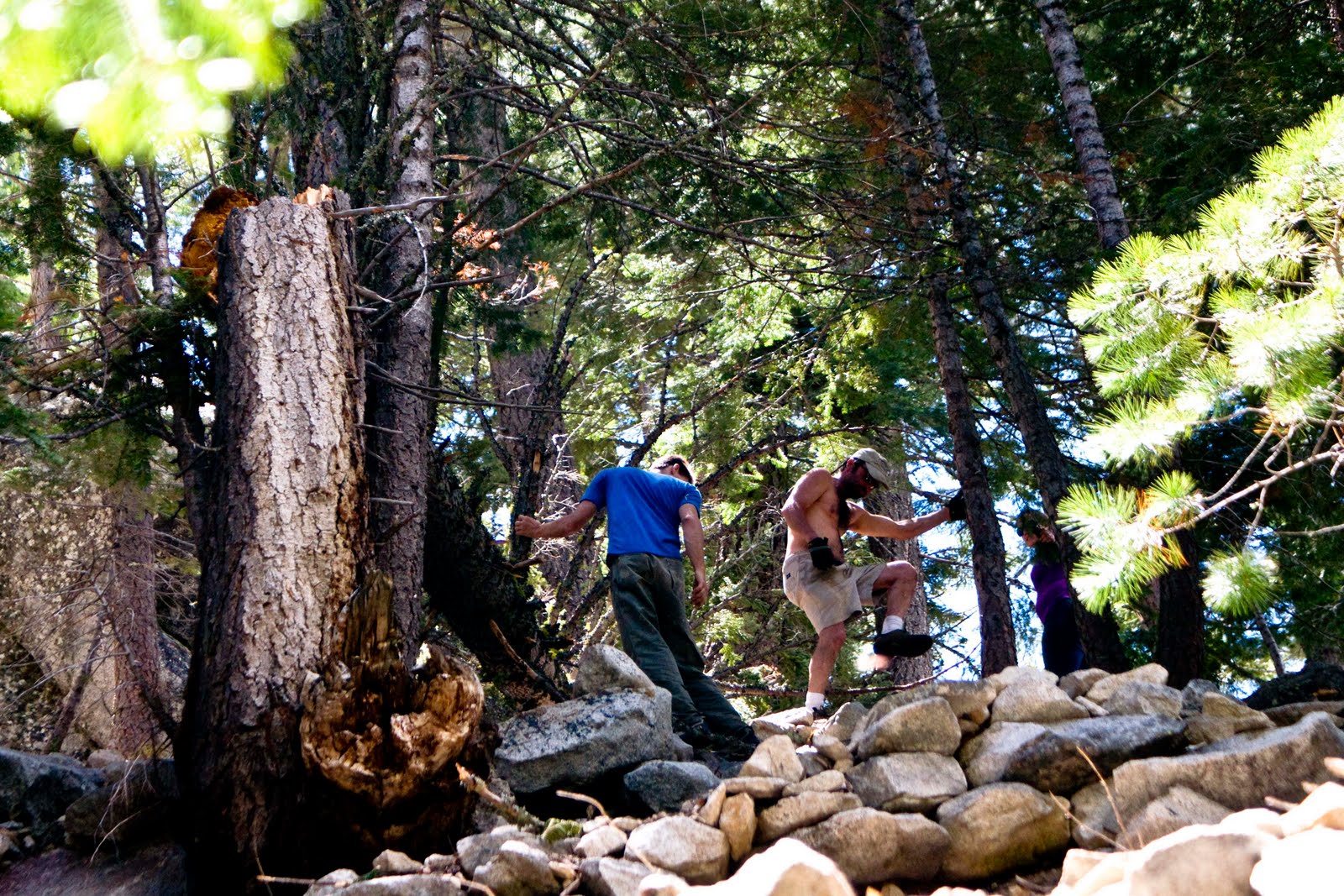
All the picnic tables were scraped of old paint and repainted (mostly by our youngest helpers, who ended up wearing a lot of paint themselves). Apologies to the parents (who were wonderful at supervising and exceptionally patient with the extra paint!). :-) We also had teams of volunteers raking and sweeping all the trails through the campground as well as within the sites. It was incredible how much fresher the sites looked after their careful work!
Fire pits were emptied, and loads of new firewood (from fallen trees) was chopped and stacked. I wish I could have seen the looks on campers’ faces who returned to find a stack of new nice wood waiting in their sites. Our wood choppers did a lot of hard labor and made huge progress in just a few hours.
Another group headed up near the main wall to rebuild a retaining wall. One of those volunteers remarked that he’d been wanting to fix it for ages. With a good team of motivated people, the job was quickly accomplished.
Around 1 PM, the sites looked ready, wood was chopped, steps were built, and everyone was hungry! Our injured leader Brian, eager to participate where he could, manned the grill despite crutches, and everyone enjoyed lunch together while sharing what they had been off working on. Several groups hiked off after this to squeeze in a few climbs before sunset.
The Leap is one of the most spectacular climbing areas in northern California, and CRAGS was excited to partner with local park services in this adopt-a-crag event in order to show our support and bring people together in the climbing community. Special thanks to all the new faces that came! We are excited to meet you and look forward to seeing you at more events.
Photos coming soon!
~Renee

The park rangers arrived exactly on time and were full of ideas and supplies! We split into groups and began preparing the campsites and some approach areas for the upcoming season.
While we moved from site to site, someone commented how it felt like we were providing room service to the campers. It did feel like that! The campers left their belongings at the sites while they went out to climb or hike, and we came through during the day in a flurry of housekeeping activities, leaving the sites sparkling clean for their returns.
All the picnic tables were scraped of old paint and repainted (mostly by our youngest helpers, who ended up wearing a lot of paint themselves). Apologies to the parents (who were wonderful at supervising and exceptionally patient with the extra paint!). :-) We also had teams of volunteers raking and sweeping all the trails through the campground as well as within the sites. It was incredible how much fresher the sites looked after their careful work!
Fire pits were emptied, and loads of new firewood (from fallen trees) was chopped and stacked. I wish I could have seen the looks on campers’ faces who returned to find a stack of new nice wood waiting in their sites. Our wood choppers did a lot of hard labor and made huge progress in just a few hours.
Another group headed up near the main wall to rebuild a retaining wall. One of those volunteers remarked that he’d been wanting to fix it for ages. With a good team of motivated people, the job was quickly accomplished.
Around 1 PM, the sites looked ready, wood was chopped, steps were built, and everyone was hungry! Our injured leader Brian, eager to participate where he could, manned the grill despite crutches, and everyone enjoyed lunch together while sharing what they had been off working on. Several groups hiked off after this to squeeze in a few climbs before sunset.
The Leap is one of the most spectacular climbing areas in northern California, and CRAGS was excited to partner with local park services in this adopt-a-crag event in order to show our support and bring people together in the climbing community. Special thanks to all the new faces that came! We are excited to meet you and look forward to seeing you at more events.
Photos coming soon!
~Renee
Friday, May 14, 2010
June 5, 2010 - Lovers Leap Adopt-a-Crag Event

On June 5, we are going to be assisting the park services with preparing Lovers Leap for the new climbing season! Please join us by meeting at 8am at Pipeworks Climbing Gym (116 N. 16th St., Sacramento) to carpool. We look forward to seeing you!
Friday, April 9, 2010
Access Fund Summit - Trip Report (by Renee)

Above all, remember that you’re a climber. –Paul Morley from SECC
At the end of March, Brian and I flew down to Vegas for the Access Fund Summit. Brian had been the previous year, but this was my first time. And my expectations were blown away.
Brian had looked up the building we were meeting in in Blue Diamond, which is just outside the city, and he joked that it looked like an igloo. Ironically, it turned out to be the coldest building I’ve ever spent time in. This includes my office, where I am forced to wear a sweater during 100+ degree
It was worth every freezing minute.
I knew I liked these people as soon as I saw they’d included nutella in the breakfast spread. We began with introductions and then a panel discussion. Next, Brian led a discussion on partnering with federal agencies, and then
Some key ideas I noted:
-Hold climbing season movie nights or slideshows to build community.
-Friends of J-Tree sponsors “Climbers’ Coffee” where they fund the materials for park services to host the event…this builds their relationships.
-An MOU (memorandum of understanding) lets you be the voice for your group.
-There are a variety of ideas for membership. Some groups prefer to do lifetime membership to simplify the process and focus on other events instead of the constant effort to renew members.
-It’s useful to partner with other outdoor groups. Home owners may also be interested in your efforts.
-There will be people who misuse resources…try to outnumber them with good deeds.
-Volunteering to do work for the park services is a win-win. They get credit for your volunteer hours. Volunteering also leaves everyone with a feeling of ownership for the area.
-Holding a retreat for your board helps everyone focus and plan the goals.
-Lisa from
-Discussed the Freedom of Information Act and how it’s helped in many situations. Similar policies exist under different names at the state level.
-Focus on the job spin to get government attention…if developing your area will affect the job situation positively, point that out!
-Don’t do events that compete with guide services.
-We need to work on linking to each other’s LCO websites.
After a delicious lunch that Amy arranged, and a quick thaw outside in the sun, we returned for the afternoon session. Steve discussed NEPA, the National Environmental Policy Act, and armed us with some great materials to take home. Jason talked about fixed anchors after that. I learned that federally designated wilderness is defined as not allowing mechanized (like mountain bikes) or motorized (like drills) equipment in the grounds. Federal services include Park Service, Forest Service, BLM, and Fish & Wildlife territory.
Finishing in the early afternoon, we took a quick group pictures and made a move out to the rocks! The majority of us rolled into Calico and spread out. I was already impressed by my peers, but this is where I became really impressed. I have never experienced a group of so many people, who had mostly just met, climbing so well together. But it was really that simple. We were all ecstatic to be there, playing on incredible rock in a new place.
Within very little time we had a wall of top ropes set up so the majority of people could rotate and climb their fill, while those who had fit ropes into their luggage led harder climbs on the other three sides of the rock. I haven’t “warmed up” on a hard 11 in a long time…these folks weren’t messing around! Special thanks to the locals that quickly told us where to go and what was what. I loved getting to climb with so many new people who adore the sport.
Sunday morning was kicked off by Paul’s “Strength and Motivation” presentation, appropriate for someone who had gotten up at 5:30am to try to send a problem before the session started. The SECC is one of the more accomplished LCOs, and hearing what the experienced organizations have been able to accomplish was truly inspiring. The idea that we could purchase land to preserve climbing…wow. These groups are making the unbelievable happen.
Kevin and Greg followed this with a discussion on handling raptors and proposed closures. I learned a lot and was really impressed by the amount of work that the San Diego LCO has put into this. Another expert from the east coast, Anthony, spoke about climbing management plans, and then Jason & Doug talked about planning and historic designations. (Note to self: definitely go climb at City of
A few more things I noted:
-“Teamworks” teaches kids about conservation by creating friendly competition.
-Discussed insurance options…something we all need to consider
-Seasonal newsletters are a good way to stay in touch
-Climbing with different people from your normal crew gives you new perspectives on your community and its needs.
-Compromising with a raptor advisory is better than a closure if the birds aren’t at risk
-Don’t forget local university resources
-State Historic Preservation Office could be useful
-Have a personal mission as well as your org’s mission
Overall, an amazing weekend full of great knowledge and energetic, motivated climbers. Thanks to Amy, Brady, and Dean from the Access Fund for putting together such a great event!
~Renee
Saturday, March 20, 2010
Minutes from 3/9 - CRAGS
Attendees: Gordy, Renee, Brian, Ellen, Rob
Apologies: Aaron, Jason
-Brian met with Schroder & Finnigan (sp?) about Auburn and is awaiting a response
-Tax status: still getting push-back. Ellen and Brian to craft a new letter. (Done)
-Leap clean-up
-Have 3 local contacts that are helpful
-Rob is working the recycling angle
-Question raised as to if we could offer volunteers a free pass in trade?
-Jason's CRAGS' facebook page will help with advertising - maybe mid-May to start recruiting
-June 5 tentatively marked for this, but will have to see about weather
-Blog: Aaron added new educational material
-Want to put general membership on the next agenda. Could consider doing a newsletter.
-Next board meeting scheduled for Thursday, April 15, 7pm at Pipeworks.
Thanks,
Renee
Apologies: Aaron, Jason
-Brian met with Schroder & Finnigan (sp?) about Auburn and is awaiting a response
-Tax status: still getting push-back. Ellen and Brian to craft a new letter. (Done)
-Leap clean-up
-Have 3 local contacts that are helpful
-Rob is working the recycling angle
-Question raised as to if we could offer volunteers a free pass in trade?
-Jason's CRAGS' facebook page will help with advertising - maybe mid-May to start recruiting
-June 5 tentatively marked for this, but will have to see about weather
-Blog: Aaron added new educational material
-Want to put general membership on the next agenda. Could consider doing a newsletter.
-Next board meeting scheduled for Thursday, April 15, 7pm at Pipeworks.
Thanks,
Renee
Subscribe to:
Posts (Atom)


